A workshop environment can add a lot of personality to a game, but only if it feels functional and lived in.
Many 3D scenes include tools, benches, and industrial props, yet still feel artificial. The problem is usually not the quality of the models themselves. It is the lack of logic behind the space. When props are placed randomly, scales do not match, materials feel inconsistent, or every surface looks too clean, the workshop stops feeling like a real working environment and starts looking like a showroom.
Believable workshop environments are built on purpose. Every object should suggest activity, routine, and human use. Whether you are designing a mechanic garage, a crafting station, a repair room, a survival shelter, an industrial corner, or a VR training scene, the same principle applies: the environment must look like people actually work there.
In this article, we will break down the key elements that make workshop environments feel credible in games and how to build them more effectively for real-time production.
Why Workshop Environments Often Feel Fake
A lot of workshop scenes fail for a simple reason: they contain tools, but they do not contain workflow.
There is a big difference between a scene filled with random props and a space that feels designed around actual use. In a believable workshop, objects are not only visually interesting. They are placed where they make sense. Tools sit near the surfaces where they would be used. Heavy items are stored logically. Frequently handled objects are easier to reach. The environment tells a story about tasks, habits, and repeated actions.
When this logic is missing, the scene feels staged. Even good models can look unconvincing if their placement ignores function.
That is why strong workshop design begins with a simple question: what happens in this space every day?
Start with the Function of the Space
Before adding props, define what kind of workshop you are building.
A believable environment depends on purpose. A woodworking bench, a mechanical repair station, a survival crafting area, and a vocational training room all use tools differently. The objects may overlap, but the layout, density, and visual priorities should change.
For example:
- A mechanical workshop may focus on drills, pliers, wrenches, cutters, a toolbox, and a heavy workbench.
- A crafting station in a survival game may feel more improvised, with fewer clean storage solutions and more visible wear.
- A VR or educational training scene may look more organized, with clearer tool visibility and safer spacing.
- An industrial maintenance room may feel more practical, compact, and efficiency-driven.
Once the function is clear, prop selection becomes easier. You are no longer decorating. You are supporting an activity.
The Essential Elements of a Believable Workshop
A convincing workshop usually relies on a few core categories of props working together.
Workbench or Table
The workbench is often the visual and functional center of the scene. It anchors the environment and suggests where most hands-on activity happens. A believable bench should feel sturdy, used, and integrated with the tools around it.
Bench Vise
A vise immediately adds realism because it suggests actual fabrication, repair, or modification work. It makes the workstation feel active rather than decorative.
Toolbox or Storage
A toolbox helps explain where portable tools belong when they are not in use. It also adds visual structure and supports the logic of the space.
Hand Tools
Pliers, cutters, screwdrivers, wrenches, and utility knives are small but extremely important. These are the props that make the environment feel human-scaled and task-oriented.
Power Tools
Drills, heat guns, and angle grinders help communicate the type of work happening in the space. They also add silhouette variety and stronger industrial identity.
Cutting and Shaping Tools
Handsaws, files, and similar tools reinforce practical use. They help break repetition and make the workshop feel more complete.
A good workshop scene does not need hundreds of props. It needs the right categories, chosen with intention.
Props Placed at Random vs Functional Space Design
This is where many scenes either succeed or fail.
A random prop layout often looks like this:
- tools scattered evenly for visual balance
- objects floating in isolated positions
- no clear work zone
- no connection between tool type and placement
- every asset visible at once
- no sense of repetition or habit
A functional layout works differently:
- the bench acts as the main work area
- commonly used tools stay close to hand
- heavier or larger items occupy stable positions
- portable items cluster where a worker would naturally leave them
- storage supports the logic of the scene
- empty space exists where activity needs room
Real spaces are not arranged to show every object perfectly. They are arranged to support use. That is why slightly imperfect organization often feels more believable than a perfectly balanced composition.
Use Placement Logic to Tell a Story
Object placement is one of the strongest forms of environmental storytelling.
A drill placed on the bench next to a vise suggests recent work. Pliers near cut materials imply assembly or repair. A toolbox slightly open feels more alive than one placed as a clean decorative block. A utility knife near the edge of a table can suggest repeated use, haste, or a work-in-progress moment.
You do not need dramatic storytelling. Small clues are enough.
Think in terms of zones:
- main work zone for active tasks
- tool access zone for frequently used items
- storage zone for secondary objects
- support zone for larger or less frequently moved assets
This kind of layout creates a natural rhythm in the scene. It also helps avoid the common problem of visual noise without purpose.
Scale Consistency Is More Important Than Many Artists Think
Even strong models can break immersion if scale is inconsistent.
Workshops are full of objects the player already understands in real life. That makes scale errors much easier to notice. A toolbox that feels too large, a drill that looks too small, or pliers with exaggerated proportions can make the whole environment feel unreliable.
Believable workshop scenes benefit from:
- realistic size relationships between hand tools and furniture
- consistent thickness and proportion across related objects
- clear distinction between handheld tools and static workshop elements
- correct visual weight for heavy items like a vise, table, or large toolbox
Scale also affects interaction. In first-person games, VR scenes, and close-up renders, inaccurate proportions are even more obvious. Workshop props should feel like they belong to the same physical world.
Wear Makes the Space Feel Used, Not Just Modeled
A workshop should rarely look untouched.
One of the easiest ways to make a workshop believable is to show signs of repeated use. The key is to do it with control. Too much damage everywhere can feel exaggerated, but a complete absence of wear makes the space feel sterile.
Useful wear details include:
- edge wear on metal tools
- subtle scratches on frequently handled surfaces
- dust accumulation in corners and less-used areas
- slight discoloration on work surfaces
- scuffs on toolbox edges
- use marks on bench tops
- material variation in grips, handles, and coated surfaces
Wear should follow behavior. A workbench surface will age differently from a toolbox lid. Pliers wear differently from a heat gun. Functional realism is more convincing than generic grunge.
Material Consistency Holds the Whole Scene Together
Believability also depends on how materials relate to one another.
In workshop environments, you often combine painted metal, brushed metal, rubber, plastic, leather, wood, and coated surfaces. If roughness values, edge response, or surface detail vary too wildly without reason, the scene starts to feel disconnected.
A believable workshop needs:
- materials that share the same world and lighting logic
- realistic contrast between metal, rubber, wood, and plastic
- controlled roughness variation
- consistent texel density and detail treatment
- believable age differences without visual chaos
For example, a brand-new glossy plastic drill next to a heavily worn matte workbench can work, but only if the contrast feels intentional. Otherwise, the environment looks like assets from different projects placed together.
Avoid the “Showroom” Problem
A common mistake in workshop scenes is making everything too neat, too visible, and too clean.
This often happens because artists want every prop to be readable. That makes sense from a presentation perspective, but it can weaken environmental credibility. A real workshop usually has overlap, partial obstruction, visual hierarchy, and uneven distribution.
To avoid the showroom effect:
- do not place every object front-facing
- let some tools rest at slight angles
- cluster related objects instead of spacing them evenly
- leave some surfaces partially empty and others more active
- use one or two focal areas rather than making everything equally important
A believable workshop should feel organized enough to function, but not staged for a catalog photo.
Build Around Workflow, Not Decoration
The strongest workshop environments are built around action.
Ask yourself:
- What is being repaired, assembled, or cut here?
- Which tools are used most often?
- Where would someone stand while working?
- Which objects need quick access?
- Which assets stay fixed in place?
- Which surfaces collect the most wear?
When you answer these questions, the layout becomes easier to solve. The scene starts to feel like a workspace instead of a random collection of industrial props.
This is especially useful in game production, where environmental storytelling must be readable quickly. A good workshop should communicate function at a glance.
How a Tool Pack Can Speed Up Workshop Scene Building
Creating believable workshops from scratch can take a lot of time, especially when you need a range of tools that feel consistent in style, scale, and material quality.
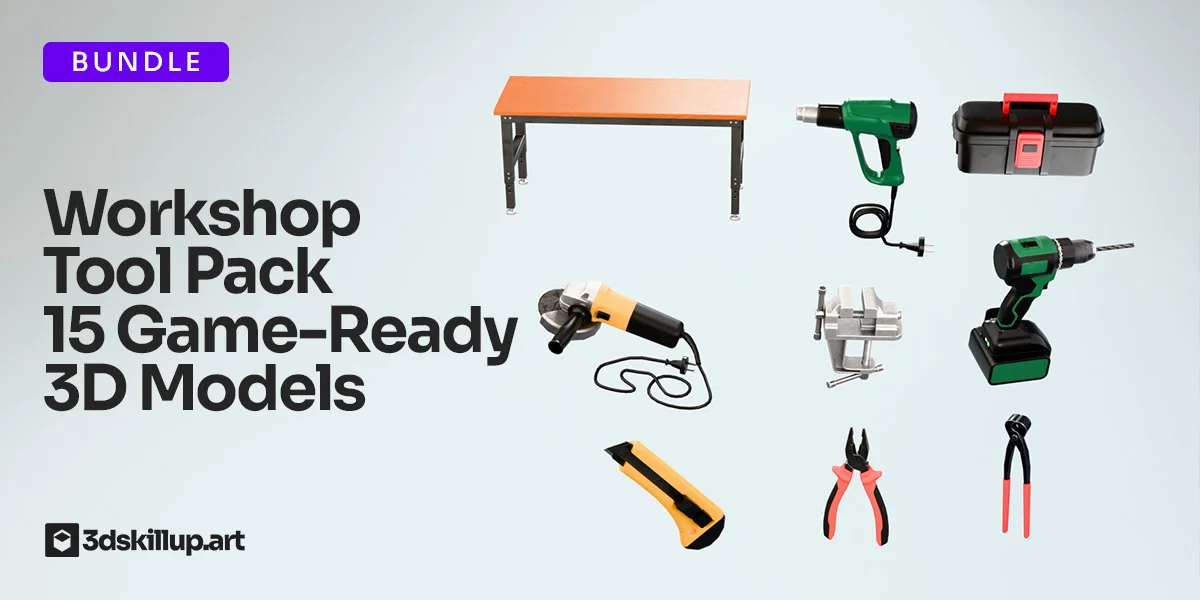
That is where a dedicated prop collection can become very practical. A Workshop Tool Pack with game-ready 3D models gives you a strong starting point for building believable workspaces without modeling every object individually. A set that includes essentials such as a workbench, bench vise, toolbox, drill, pliers, cutters, saw, heat gun, utility knife, angle grinder, and other hand tools can help you establish functional variety much faster.
This becomes even more useful when the assets are already optimized for real-time use, built with clean topology, and prepared for engines like Unity, Unreal Engine, and Blender. Instead of spending production time rebuilding common workshop props, you can focus on layout, storytelling, interaction, and scene composition.
Used well, a pack like this does not replace good environment design. It supports it by giving you a believable foundation.
Workshop Environments Feel Real When They Suggest Human Presence
At the heart of every believable workshop is the idea of use.
The player should feel that someone has worked here, returned here, solved problems here, and left traces of routine behind. That feeling does not come from one hero prop alone. It comes from relationships between objects, materials, wear, and space.
A workbench with no surrounding logic feels empty. A collection of tools with no functional arrangement feels random. But when the bench, vise, toolbox, drills, pliers, cutters, and saws all work together inside a clear visual system, the environment starts to feel convincing.
That is the difference between a room with props and a workshop with purpose.
Final Thoughts
Building a believable workshop environment in games is not about adding as many industrial assets as possible. It is about making the space feel functional, coherent, and used.
Start by defining the purpose of the workshop. Choose props that support that purpose. Use a logical layout instead of random placement. Keep scale consistent. Add wear where it makes sense. Make sure materials feel like they belong to the same world. And most importantly, think about workflow, not just decoration.
If you want workshop scenes to feel more immersive, small decisions matter. A bench placed correctly, a tool left within reach, a vise mounted where it belongs, or a slightly worn handle can do more for realism than dozens of extra props scattered without thought.
For artists and developers who want a faster way to build this kind of environment, a Workshop Tool Pack can be a very efficient starting point—especially when it provides a complete set of real-time-ready assets for scene dressing, gameplay interaction, visualization, and production work across Unity, Unreal Engine, and Blender.